Wednesday, 21 December 2011

Lighthouses and elephant seals

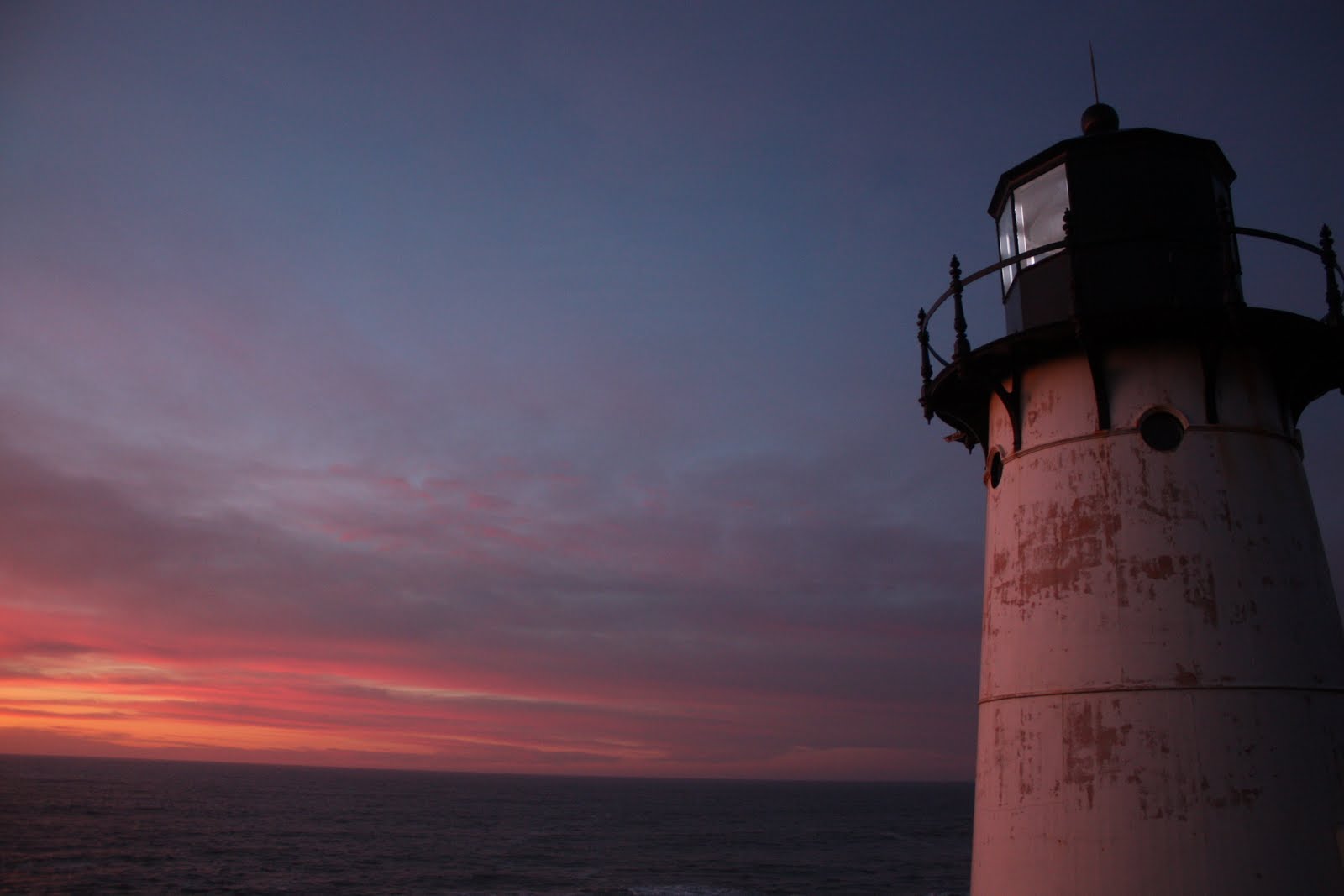
Today we traveled from one lighthouse hostel to another. We're currently staying in the grounds of the Pigeon Point lighthouse, one of the tallest lighthouses in America. This afternoon we attempted rockpooling (or tidepooling as they call it here) again, but the tide just wasn't low enough. We did see a lot of sea anenomes clinging to the rocks like barnacles. From beside the lighthouse we spotted harbour seals lounging on the rocks, and raising their heads and tails in the air when waves were approaching. We also spotted two, maybe even three migrating grey whales on their southbound journey.

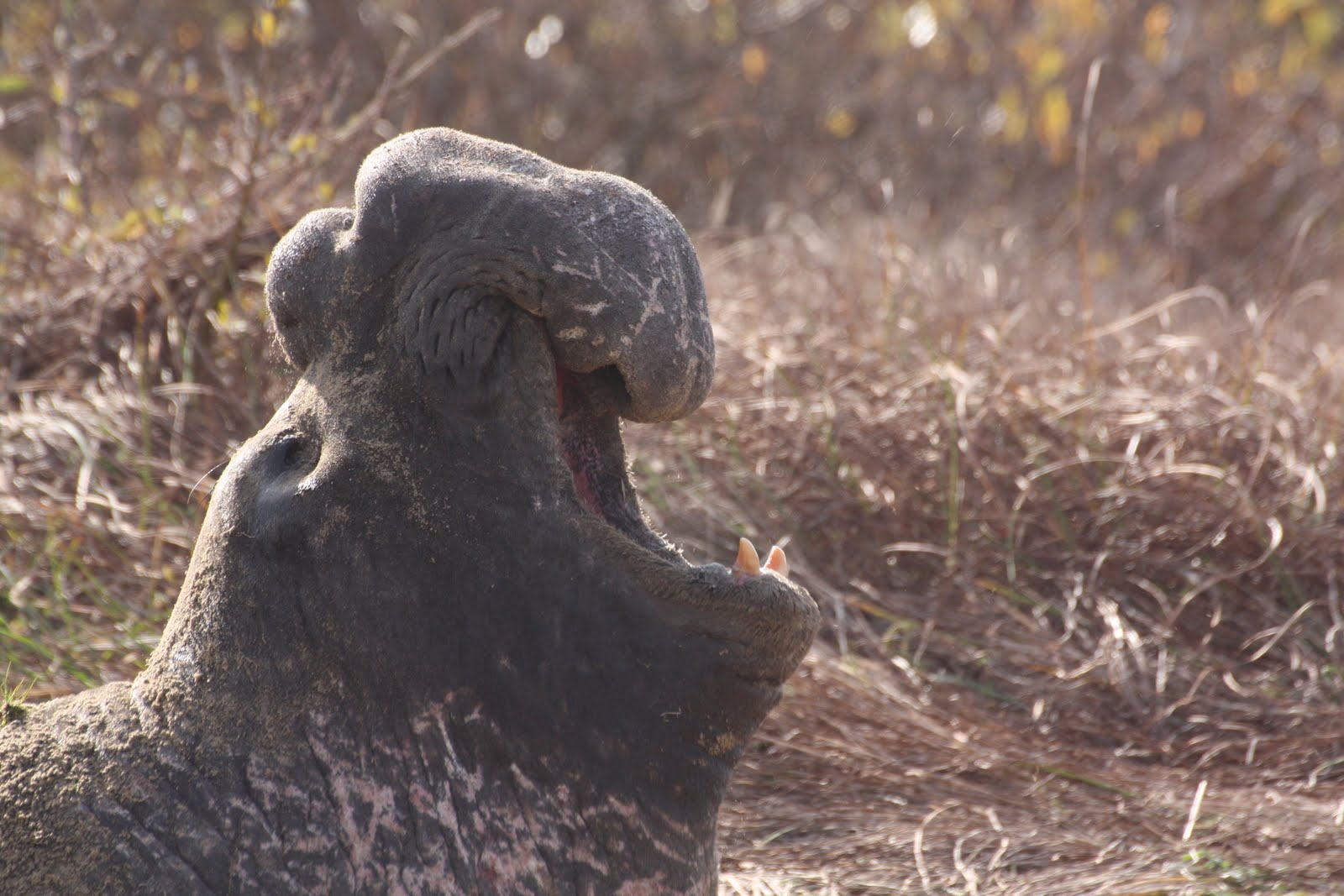
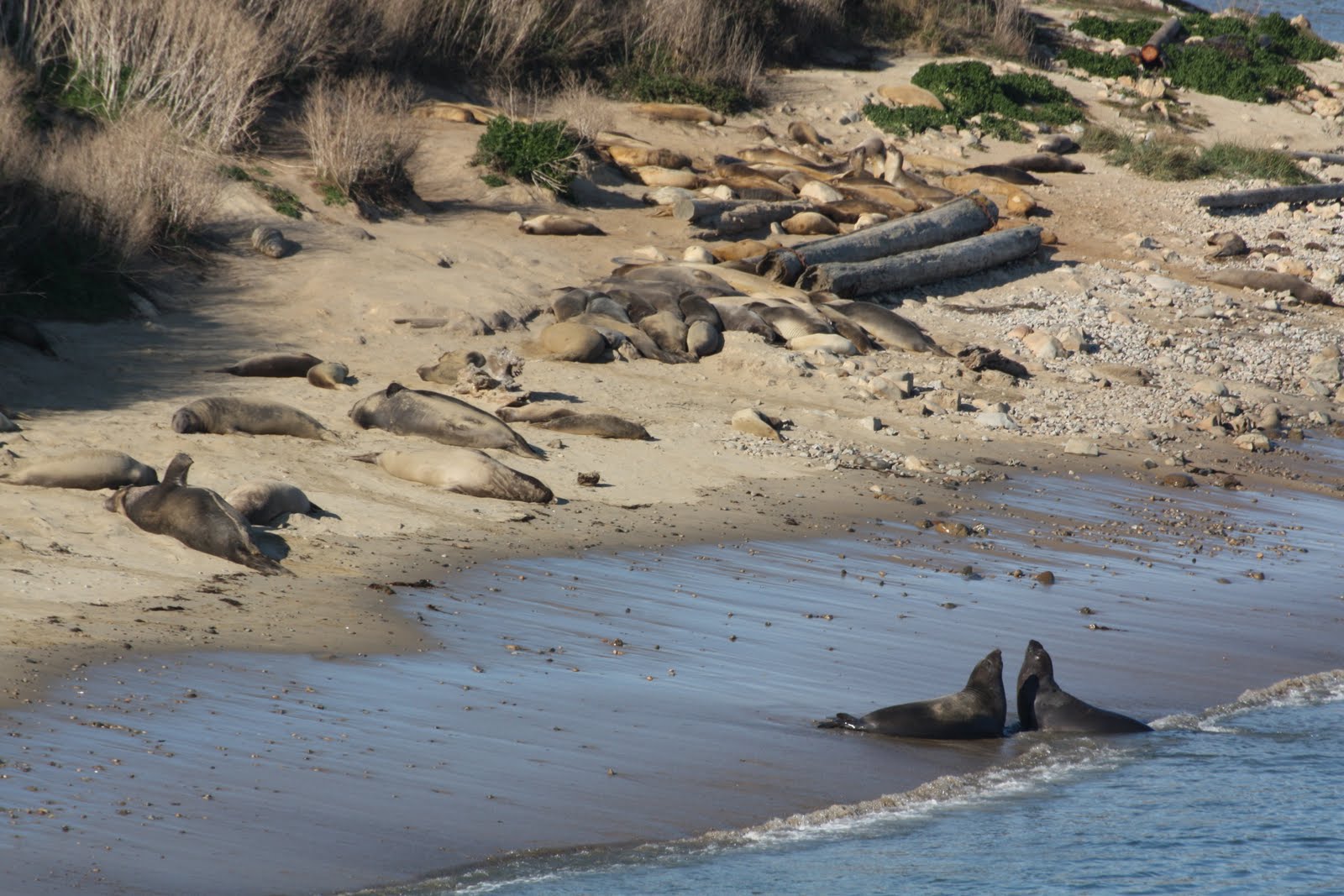
Elephant seals were however the main attraction of the day. At 10.30a.m. we left from the Ano Nuevo State Park visitor centre on a 'docent' guided tour to the elephant seal colony. In November/December the huge male elephant seals return to shore and begin sparring with each other. The females arrive in December, shortly before giving birth. The dominant males establish large harems of females. About four weeks after birth the pups are weaned and left to fend for themselves, while the female seals mate and return to the sea. Usually by now they would be seeing pups already born at Ano Nuevo, but this year the females seem to be late to come ashore.

Our walk led us to the dunes, to viewing areas and right between sleeping males. We didn't see any pups, but some heavily pregnant females and many many males, some huge with large proboscises. The males make a tremendous bellowing sound. more to follow...

Tuesday, 20 December 2011

To Montara Point Lighthouse

The morning was spent navigating San Francisco without going on the massive freeways and highways (they scare me too much), shopping for provisions (and somehow managing to buy brussel sprouts for $11.26) and driving to the Montara Point Lighthouse further to the South. We then went for a walk to the Fitzgerald Marine Reserve, where there are good rockpools. The tide was too high but we saw quite a few harbour seals instead. The hostel here is in the buildings surrounding the lighthouse and rather picturesque.

Monday, 19 December 2011

Point Reyes and the Marin Headlands (17th and 18th)

With the best of intentions to get up early and walk along the spit our morning plans went awry. The previous evening two Canadian hitch-hikers had arrived at the hostel and when they weren't singing were trying to find a ride on to Portland. We decided we could take them to the main road after our spit walk. They got a better offer though from the mysterious Brian who had also appeared at the hostel that evening. He was driving to Bandon, Oregon which would get them most of the way. Having arranged to leave with Brian around nine they were getting ready only to discover that he'd returned his sheets, asked a few questions and went on his way an hour earlier. Some discussion followed as to whether he'd purposely 'forgotten' the Canadian girls or had really just forgotten them. Without much chance of getting to the highway for a few hours we offered to take them and forget our walk. Kate who works at the hostel was right when she said we wouldn't need to turn the radio on with them in the car, they started singing almost straight away!

The rest of the day was spent driving, trying to walk but deciding not to because there were too many horses (too much like a normal day down Harcombe Road), driving to the South of Point Reyes and going for a short coastal walk (it's hard to keep going when you know you just have to go back the way you came, have they heard of circular walks?), driving past a few arrays of photovoltaic panels, listening to Christmas music (or American Christmas music which isn't proper Christmas music at all), visiting the hippie ville of the area- Bolinas (had a BC island feel to it), walking at Stinson Beach which according to a guidebook 'can't fail to impress' (well it did), winding round the bendy road along the coast, stopping at lookouts to take pictures, stopping at lookouts to let cars past, looking at what may or may not be 'the longest row of mailboxes in the States, trying to find a way not to go on the freeway, failing to find a way not to go on the freeway and you've guessed it- finally driving on the freeway.

Our day at the Marin headlands began with an early start to watch the sunrise over the Golden Gate Bridge from the lighthouse. Unfortunately the lighthouse and the path to it was closed so we just had to content ourselves with watching the sunrise from the car-park. The sunrise did not manage to fully justify the 6.15a.m. start. Most intriguing was this luminous or certainly unnatural looking green fibre plastered on the soil along most of the roadside. It was bright blue on the underside, but we later learned from the park ranger that this is a native seed, grass and fertiliser mix that has been sprayed from a truck where the grass has been disturbed.

After our unsuccessful lighthouse trip we took a walk to the marine mammal center and went on a 'docent' (they seem to have an obsession with this word here) led tour of the facility, which was interesting. There weren't many patients though, just seven sealions and two fur seal pups. They had a variety of maladies and the fur seals weren't eating. One of the sealions has some condition they know very little about with air bubbles in it's brain. The facility is in part powered (only about 15%) by photovoltaic panels above the cages, which also provide shade for the animals. Production was at 3.3 kW on this overcast day.

The rest of the day was spent in a desperate search for my wallet, searching through all our bags and all nooks and crannies. I did finally find it though wrapped inside the towel from the hostel. Now I just better not lose it again!

Still in Point Reyes (16th December)

It wasn’t the best of starts to the morning, woken by a lady and a child traipsing with their torches in their hands to the toilet at the other end of the room, and kept awake by the two ladies in our room who were evidently stuck in some other time zone having gone to bed at 8.30 p.m and then thinking six o’clock was a civilised time to start asking each other in loud voices how they had slept. I think I place too much value on sleep. We were going for a hike along the Drakes Estero Trail, but first got side-tracked by the promise of mountain views at Mount Vision, accessed by Mount Vision Road. The road wound into the hills for what seemed like forever and with no vision onto a view, although past many flickers and beautiful lichen draped trees. Eventually we found a view after a short walk up the hill and through an area that looked very much like Stonebarrow with a view that looked very much like the Dorset coast.

Having wound our way back down the hill of vision we did finally make it to the head of the Estero trail, but found it difficult to get ourselves going. Having eaten copious flapjacks, visited the outhouse and just getting started on extolling the virtues of the copious toilet paper situation among the outhouses of Point Reyes National Seashore Jenny spotted us a bobcat just visible on the side of the hill. We then observed as the bobcat, which looked very much like a cheetah, prowled through the grassland and waited patiently before pouncing at some prey. Not being successful it moved on to another patch and then came straight down towards me. I did get a bit scared (having heard too many cougar and bear stories over the past months..), but moving my camera and telephoto lens from my face, realised it really didn’t look like much of a threat.


Drakes Estero trail wasn’t greatly exciting, there were lots of birds, but we couldn’t see them well and even if we could have we wouldn’t have known what they were. The trail allows ‘the observant hiker opportunity to see owls perched in the pine trees’ according to information at the hostel. We were observing with all our might, but to no avail. But it didn’t really matter, because we saw the bobcat! Mammal watching is a far easier hobby, especially here.

Tule Elk (15th December)

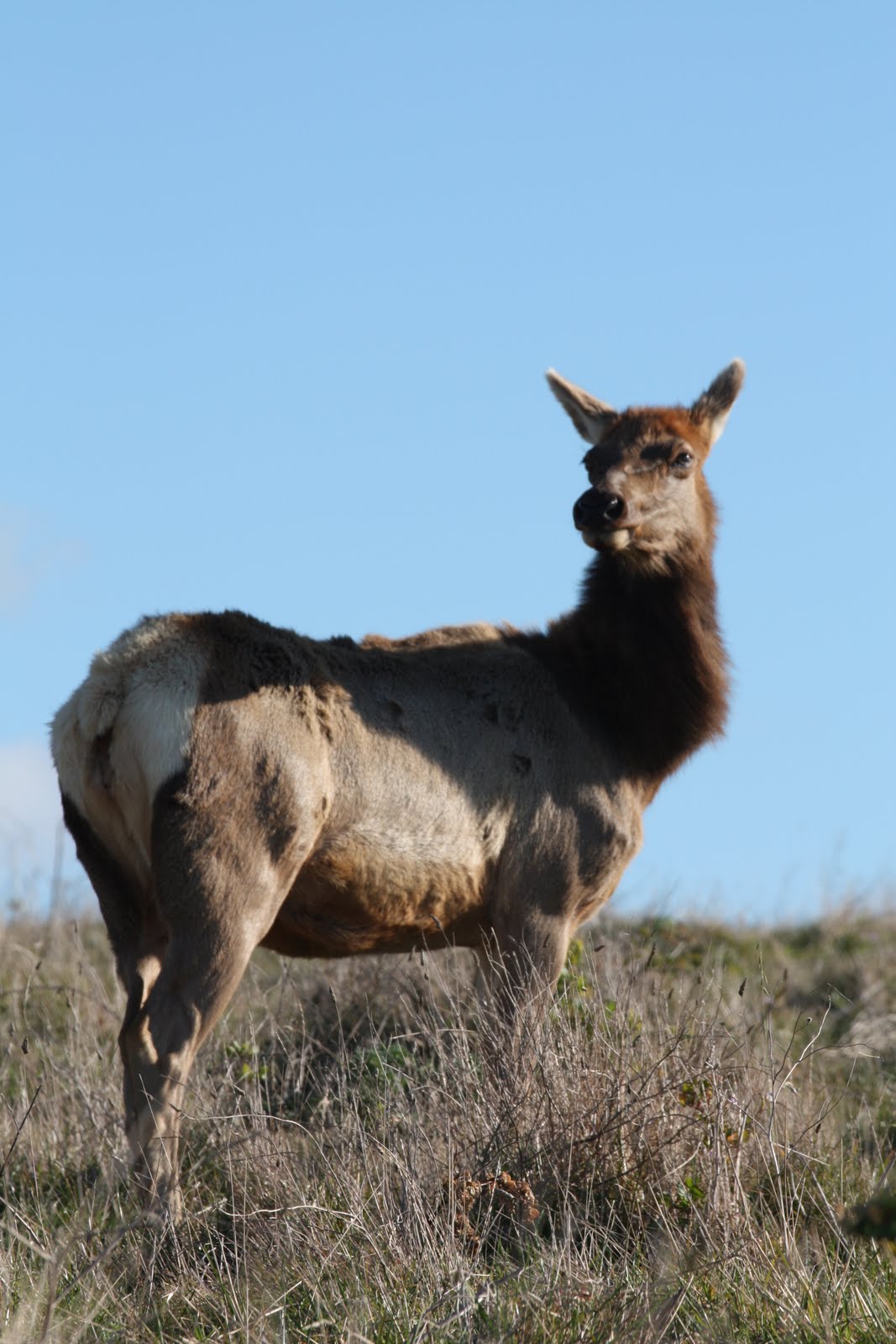
On a mission to see the Tule Elk (red deer) of Point Reyes we headed to the Tule Elk reserve in the north of the national seashore. About 400 hundred elk are confined within the reserve in an attempt to protect these reintroduced animals from contracting a chronic wasting disease that elk elsewhere in the park have caught from cattle. Seems the wildlife here catches disease from farm animals, rather than apparently gives it to them (badgers...TB…). Threatening to rain on us for the first time since our arrival in the States we left the hostel in dense fog and concluded that American cars don’t have fog lights. Just another little bit of technology that seems not to have reached these shores. As we drove on though, the fog lifted and the light was too good not to keep stopping for a few photos. A coyote ran across the road and off into the distance before I’d managed to get the right lens on the camera, a full battery and find an empty memory card. I never seem to learn.

As the road bent round to the Pierce Point Ranch in the reserve we spotted a herd of elk lounging around. On our walk in surrounds looking like a combination of Scotland, the Lake District, Cornwall and Devon we came across some flowering plants (it’s such a pleasant surprise to find all these plants flowering in California), loads of turkey vultures circling around, some hawks and as we came into a valley there were more elk. Sitting down in a valley just next to a sign telling us to stick to the path and not disturb wildlife it wouldn’t really have been appropriate to try to approach them. Continuing on our walk we began to wonder whether we should not just turn back. Coastline (as I know only too well from walking almost half of the UK’s southwest coast-path) gets repetitive, so we weren’t sure if we needed to see the end of the Tomales Point Trail. Jenny was striding ahead to see over the next hill while I took some photos and I couldn’t understand why she kept on going and then why she was beckoning me towards her. But below us were even more elk and these were right on the path. We sneaked slowly along and the elk weren’t too perturbed to run away. They seemed more interested in listening to bird calls.

Back in the car we drove through the elk we’d seen from the road before, heard them bark and flock together as another car approached and then we spotted another whale! On a slight detour to Abbott’s lagoon in search of birds we found ourselves a bittern, lots of coots, and some sand dunes. After sitting in the car park in the wee village of Inverness and writing some letters, we drove back to the hostel in the dark and spotted two more bobcats.


Point Reyes (Wednesday, 14th December)

Today I told Jenny if I had two tick boxes, one with good day, the other with bad day, I’d definitely be ticking good day. We saw loads of California quail, stood on the San Andreas fault (even though it’s not as exciting as I’d been imagining), admired the lichen draped trees, spotted a herd of radio collared deer, spotted even more deer, saw sparring, snoozing and swimming elephant seals, plenty of harbour seals, scoters (which I for a while excited myself immensely into thinking were the elusive tufted puffins that breed all along the coast of Oregon and here too), a sealion, eight whales around Point Reyes Point and, as we were driving through the dark with a lady in tow whose car had run out of ‘gas’, another bobcat!
Point Reyes it seems abounds with wildlife!

From San Francisco to Point Reyes National Seashore (13th of December)

When we’d finally managed to make our way from the hostel to the budget rent a car, got away again with having no credit card but a sellotaped together debit car and got them to sign off the scrape the car had, we drove out of San Francisco in our huge white mafia truck (not an SUV but still..). Going over the golden gate bridge and up the hill beyond on the highway shared with another five lanes was somewhat terrifying. But we were soon on the smaller and very windy road heading to Muir Woods, admiring birds of prey and purchasing figs from a roadside stall. Muir Woods is one of the few remaining forest fragments of tall trees- coastal redwoods or Sequoia sempervirens. The redwoods are the tallest trees in the world.

Pulling into the second overflow car park we realised we were not alone in wanting to visit the redwood grove on yet another sunny day. The entrance fee into the park was $5 per person. As we sat eating our lunch loads of people emerged from the grove at once and we unknowingly both calculated their worth to the national park ($80). An Englishman, his two teenagers and a little squirt received a blank look from the ticket office man after asking if they would be able to push a buggy on the path, he got there in the end though and concluded the trail wasn’t ‘strollerable’. The trees themselves were majestic and smelt pleasant, but it was hard to get perspective and realise how tall the trees really were. As it says in ‘The Wild Trees’ book that I read a few months ago, you can only truly appreciate these trees while climbing them. A fallen down tree though gave a bit more of an idea as to how tall these trees really are.

Leaving the well-trodden tourist path behind we headed up the side of the valley passing many lichens on the ground which must have been blown from the very tops of the trees in the fierce winds that California apparently had a week ago. Unfortunately there was no longer a view from the Ocean Trail, due (as we found out from a sign when we’d finished it) to fire prevention (we might have to Google how this works..). After our walk we headed to our destination of Point Reyes hostel via a very windy road in ever increasing darkness. As we drove through the national seashore we spotted two deer and a bobcat.