This time we wont be the only passengers as the other double room has already been booked by some people on a round-trip. I find the prospect of not being the only passengers quite exciting. It's also reassuring to know that other passengers are braving the winter storms. Once again we're booking through the NSB Reisebuero- www.nsb-reisebuero.de
Showing posts with label Hanjin Yantian. Show all posts
Showing posts with label Hanjin Yantian. Show all posts
Thursday, 29 September 2011
Freighter Booked
Our freighter journey across the Atlantic is almost booked! Around the 21st of January we'll be travelling from Charleston to Antwerp aboard the MSC Flaminia. The ship is not quite as big as the Hanjin Yantian, but still large at 299m long, with a capacity of 6750 TEUs. Whenever I think of MSC though I think of the MSC Napoli, which run aground off the Devon coast where much looting ensued (we probably still have a packet of oily biscuits found on a beach). Hopefully the MSC Flaminia wont reach a similar plight.

Sunday, 26 June 2011
Hanjin Yantian
 The Hanjin Yantian is 300m long and 42m wide, carrying about 6,000 TEUs (twenty-foot equivalent units) of cargo on our trip. This is a big ship and was among the biggest until MAERSK went and built its superships. We are told it is probably owned by some rich person from the South of Germany, it’s managed by NSB- the Niederelbische Schifffahrtgesellschaft Rederei and is chartered to Hanjin, a South Korean shipping company.
The captain is Russian, living in Lithuania and extremely tall, the rest of the European crew is made up of Germans and a Polish officer. Max sits at a different table to the rest of the Europeans at mealtimes and we are yet to discover whether this is because he’s not allowed to sit on the table with the chiefs or we’ve stolen his seat there. The rest of the crew are Filipinos including the cook, the steward, one of the officers, the oilers and the able seamen. We don’t yet know what oilers and able seamen are. The Europeans work for four months and then have three months off. Some have been working on this shipping route for eight years, while others have been all over the world and seen almost all the major ports. One of them hasn’t been home at Christmas for five years and another is trying to decide when he should get off so he can spend this Christmas at home. He’d ideally like to work for a ferry company so that he can work for two weeks at a time. The Polish officer has only recently returned from his time off. The Filipinos rarely get to go home.

Each container costs about $1,000 to transport from Asia to America, with the bigger, hazardous or refrigerated containers being more expensive. At full capacity they’d be taking about $7 million for this transportation. So there’s really quite a lot of money in it. The ship gobbles up a lot of fuel though and it's by no means a green mode of transportation, but at least we're not the reason for it being on the sea, unlike an aeroplane. I forget how many gallons of fuel will be consumed during the voyage across the Pacific, but the fuel will cost in the region of $1.76 million for the 11 days.
The cooks aboard these ships are all taught to cook European style and when they first arrive apparently cook an exciting variety of dishes. However after that they just relax into a boringly monotonous menu according to the the chief engineer. The Filipinos eat a more exotic menu in a different room on the other side of the kitchen.
Friday, 24 June 2011
Busan-Hanjin Yantian in Busan (29th September)
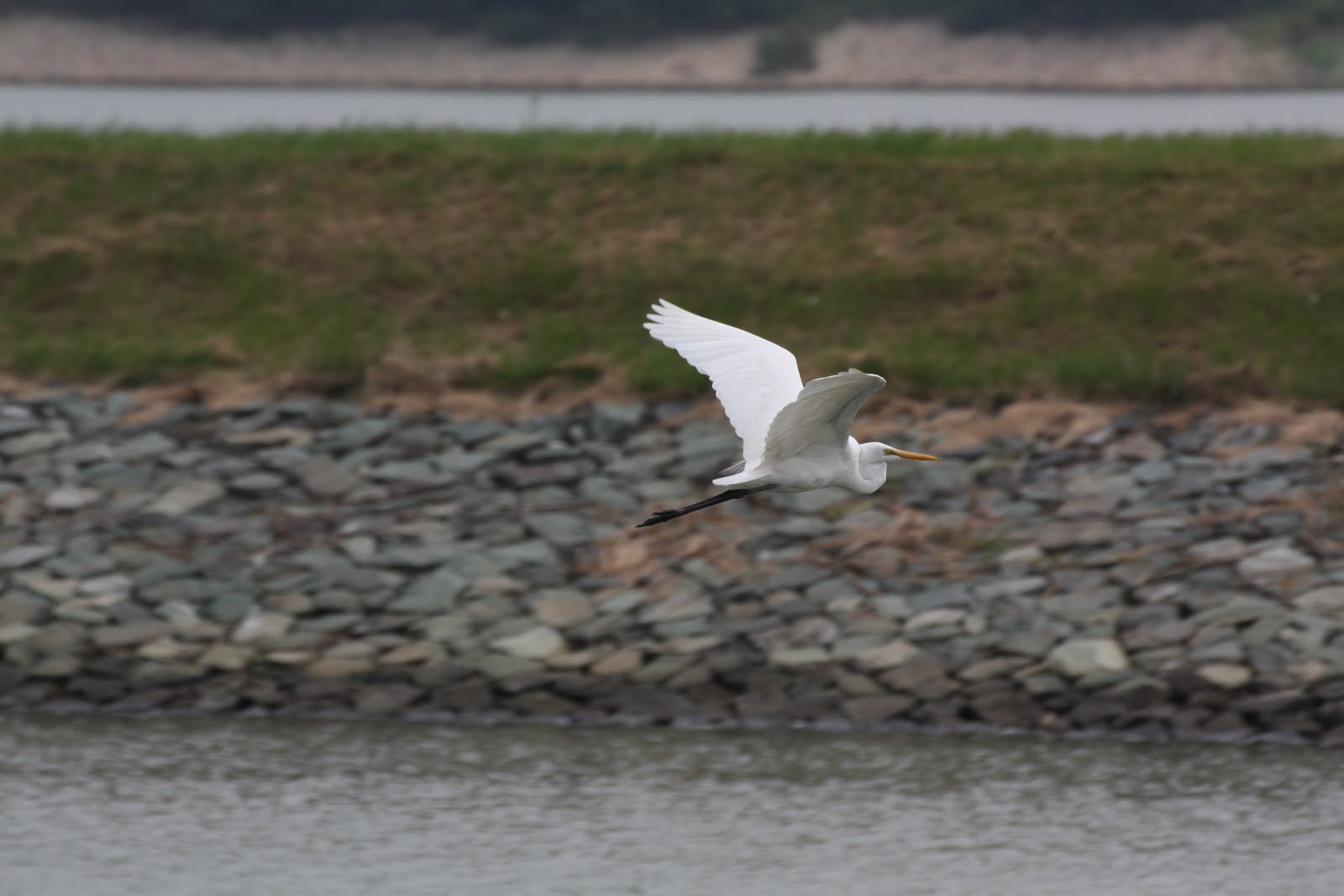 The Elsukdo nature reserve had been one of my pre-trip discoveries and we thought we at least had to visit it while we were in Busan. It’s allegedly one of the best and most famous natural wetlands in the world (well that’s what they write in their brochure). Located on an island in the estuary of the Nakdong River it is an important site for migrating birds and winter visitors. We got the subway to Hadang and then the (1500W) bus 58-1 one stop across the river. It was hard to tell where we were allowed to walk, which we thought was because we didn’t know where the path was, but actually was because there aren’t any paths. This is the kind of conservation where you have a reserve, but you don’t really allow they people in to see it. Obviously it’s good for the birds, but it might keep people interested if they could actually see something!
We walked along the tarmac road to the end of the island seeing a lot of Great Egrets, Great Herons and Little Egrets. There were also some magpies, birds of prey and the most interesting were the suicidal fish that kept leaping out the water and walloping back into it. At the end of the road was a hide, so far from the water that you’d need a super-duper telescope to see anything. There was no other path so we just had to return back the way we came. We did get greeted enthusiastically by the people fixing the lawn mowers though and were given yet more Korean offerings (chestnuts and sweets this time) from passing cyclists. Seeing as we were there we went and had a look around the visitor centre, which was gratis and quite nice. The building wouldn’t look out of place at the Expo and at the back it was even possible to see some birds out on the water.
We then went and did some shopping for tofu, fruit, vegetables and snacks in case there’s no decent food on the freighter and all we’re offered for 11 days are potatoes (apparently they don't cater for vegetarians).
Upon returning to the hostel we were told that our man from Busan (port) had phoned twice and that is was urgent that we phoned him. Apparently the Hanjin Yantian was going to arrive earlier than expected and leave at about 10a.m. on the 30th, so we could either get up early or board today. I said we’d be willing to get on today. So we had all of one hour to pack our bags, not post our postcards, book hostels and train tickets for America, phone the parents, write some emails and do or not do anything else we had time for. At 4.30 p.m. he came and picked us up just down the road from the hostel and drove for about 40 minutes to the Busan new port. He was not a man of many words (to us) or much information. His manoeuvring skills through the freight lorries whilst laughing heartily down his mobile phone where pretty impressive though. Somewhere he stopped, took our passports with him and locked us in the van. This we were later told was to get our immigration stamp. Looked like we didn’t actually have to be present for our passports to be looked at. He then proceeded to the departure area, driving at breakneck speed and then walking almost as fast through the corridors, with us running along behind him. Here he left us in the ‘Waiting Room for Sailor’s Families’ where there was internet access and noodle making facilities (warm water).

At about 6.30p.m., with the boat due in a 7.00 p.m., another smartly attired man came to pick us up in his car. Our possessions were scattered everywhere and we hastily packed them and proceeded to chase him through the corridors to his car. With all this haste we expected to find the Hanjin Yantian docked and ready for us to board. The dock was empty but for a few men standing around and the freighter was turning around in the port. As it came closer, the dockside became a hive of activity with trucks driving everywhere and the workers getting ready to spring into further action. As the A of Hanjin pulled up next to us we realised just how huge the ship was. It took some time before the walkway was pulled to the ground through a combination of human and minivan powered effort. A man came down and the two smartly dressed men waiting bowed to him. We later came to realise that he must have been the pilot who had guided the ship in. It was then our turn to get on and we were rushed up the steep steps by rushing Korean man number two. The rail was covered in black grime and I made the bad move of looking down while going up the rickety steps. Up some more steps we came to the command room from where we were then taken with the lift to our room on deck F. The rushing Korean man with Jenny’s rucksack in tow disappeared, but Stewie the steward found it and the two were reunited.

Our accommodation in the purser cabin, the cheapest passenger cabin aboard the Hanjin Yantian, is rather salubrious by our standards. There is a living room area with television and DVD player, small fridge, telephone, radio/CD player, three lamps (that

are firmly fixed to the furniture and not going anywhere), a splendid bouquet of plastic flowers, two paintings, a sofa, a table, four chairs, a dresser and a lot more cupboards with storage space. In a drawer is an elastic cord that we can tie round all the chairs and the table when the sea gets choppy. Round the corner is our bed and next to it the bathroom with four toilet rolls, two bars of soap and a box of washing powder. There is even a nifty little pull-out washing line.

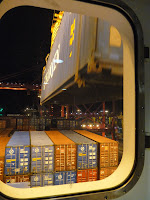
Looking out our window onto all the cargo being loaded and unloaded while in Busan was rather interesting. There were big red constructions on the dockside with arms that came to rest over the ship. A yellow thing, similar to those grabbers you find at amusement arcades, would zip along the arm and move the containers one by one onto the waiting lorries. If the amusement arcade models were as good precision tools as this grabber there would be a lot of pink panthers and fluffy piggies in the world. Right in front of us the containers were being taken off and there were a lot of them. When they’d emptied up to the level of the floor we’d entered on we thought they were finished, but then they just lifted the floor off, stored it on the dockside and continued to pull out even more containers below. They had been stacked 8 deep below the floor and 7 above. And that’s just one column of a row of 16 and there are about 48 of these rows.

Sometime in the evening Martin, who was given the task of looking after our safety and getting us to fill in paperwork, came to our room to talk to us about safety procedures. We were each given a lifejacket and a red teletubbie-like suit, which keeps you warm in an emergency. At some point we’ll have to try these on and take a few amusing pictures. The lifejackets are equipped with small flashing lights and whistles, which we have been informed are of little use when you’re a small floating object in the middle of the vast Pacific.

Subscribe to:
Posts (Atom)